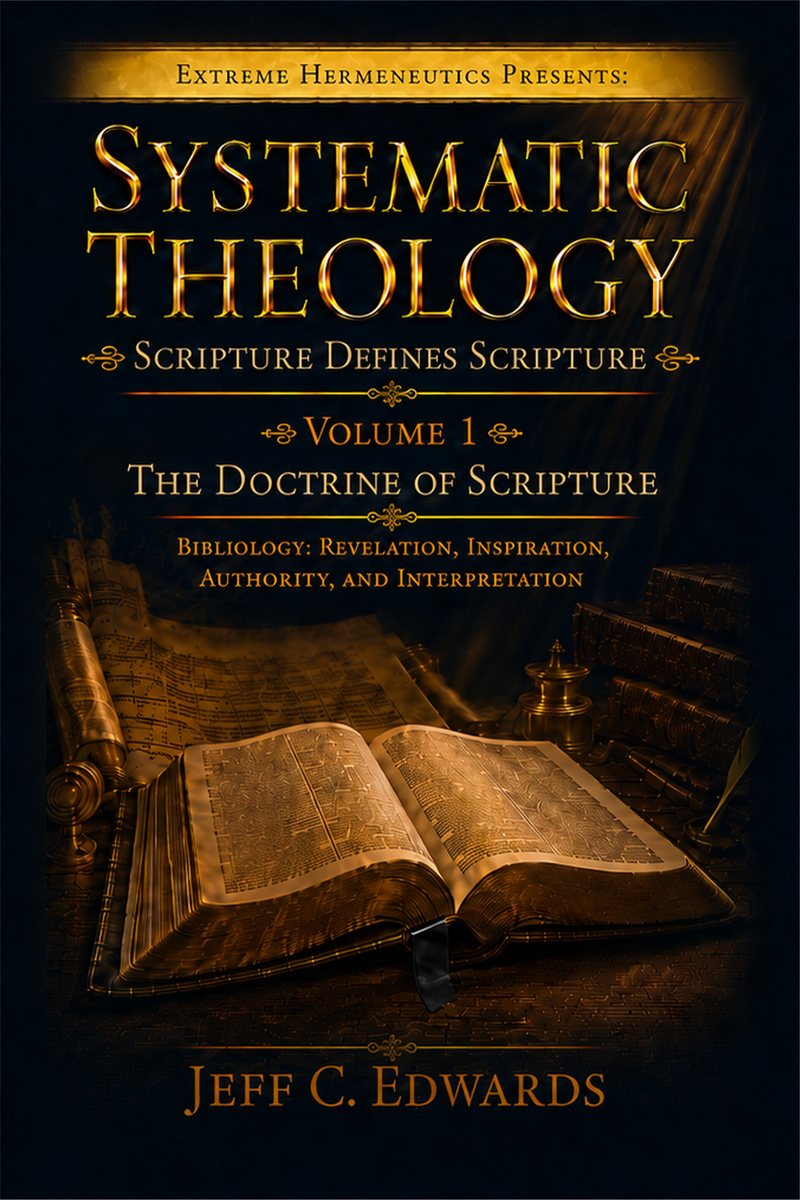
“Scripture interprets Scripture” is not a slogan for collecting verses that appear to support a conclusion. It is the conviction that God’s Word must be allowed to explain God’s Word.
Because the Bible is one revelation from one truthful God, no passage should be treated as though it exists in isolation from the rest of what He has spoken. The Bible’s own words, categories, promises, patterns, symbols, and fulfillments must govern the conclusions we draw.
01
One divine Word must be heard as one Word.
Jesus said that “the scripture cannot be broken” (John 10:35). God does not speak falsely in one place and then correct Himself in another. His revelation unfolds through history, but it does not collapse into contradiction.
That gives us confidence when passages seem difficult to reconcile. An apparent tension may reveal that we have missed a distinction, failed to follow an argument, or not yet heard all the passages that bear on the question. The answer is not to silence one text with another. It is to keep listening.
02
Start with the text that is in front of you.
Scripture interpreting Scripture does not mean skipping the immediate passage to chase a cross-reference. God placed every sentence in an argument, a book, a historical setting, and a literary form. The first question is always: What does this text say where God put it?
Only then should we ask whether other Scripture gives further light. Has this language been used elsewhere? Has a promise been repeated or explained? Has a later biblical writer interpreted an earlier passage? Does another text protect us from making a phrase say too much—or too little?
The whole Bible gives light to a passage; it does not give permission to cancel that passage.THE GUIDING PRINCIPLE
03
Let Scripture define its own words and categories.
The Bible speaks of covenant, kingdom, righteousness, grace, faith, law, Israel, church, promise, fulfillment, holiness, judgment, and salvation. Those words should not be controlled first by modern culture, a preferred system, or inherited tradition.
This does not mean every word always has one mechanical meaning. Context matters. But Scripture itself must establish the vocabulary by which doctrine is formed. The Bible is not raw material for the reader’s categories; it is the source from which biblical categories are learned.
04
Hear the whole counsel of God.
A single verse may state a truth plainly, but it should not be made to carry every question related to that truth. Scripture’s teaching is often distributed across many passages. One text may establish a claim; another may give its setting; another may guard it from misuse; another may show its implications.
The Bereans searched the Scriptures daily to test what they heard (Acts 17:11). Their example is not suspicion toward all teaching. It establishes the standard: every human claim remains open to correction by the written Word.
This calls for patience and humility. Some passages are direct and clear. Others require labor. Peter acknowledged that some things in Paul’s letters are hard to understand (2 Peter 3:16). Difficulty does not weaken Scripture; it calls the reader to greater care.
PUT IT INTO PRACTICE
Four questions to carry into your Bible reading.
- 01
What does this passage say in its own setting?
- 02
What other passages truly address the same subject or explain this language?
- 03
Do those passages refine, qualify, or confirm my first conclusion?
- 04
Am I allowing Scripture to correct my assumptions—or only looking for support?
The goal is faithfulness, not cleverness.
Scripture interprets Scripture when the reader remains under the text. The goal is not to discover a novel connection, force the Bible into a pre-decided system, or use verses selectively. The goal is to hear what God has said with confidence, patience, and humility.
God has given His people a coherent Word. Our task is to listen before we conclude, test before we repeat, and let Scripture set the limits of our certainty.